Development Courses for Educators and Supervisors
Overview
The Yorkshire and Humber deanery has commissioned a suite of courses in response to feedback from our educators on their priority development and educational needs.
Our courses provide opportunities to enhance your skills and confidence in areas including, but not limited to:
- Supporting diverse postgraduate doctors, dentists and public health practitioners in training (PGDiTs)
- Using interactive teaching tools to maximise engagement
- Leading by example and creating psychologically safe teams
- Setting, maintaining and managing boundaries to support your workplace wellbeing
This page provides you with a full overview of the courses currently on offer, booking guidance and details of self-directed learning opportunities.
To assist you with planning your development, we have grouped courses into themes and each one has been mapped to the GMC Criteria for Trainer Recognition.
Eligibility
These courses are open to Medical and Public Health doctors and dentists working in the Yorkshire and Humber region who are named or recognised postgraduate educators according to GMC / GDC criteria.
Inclusive of deputies, eligible postgraduate educators include:
- Educational supervisors
- Clinical supervisors
- College Tutors
- Training Programme Directors
- Heads of School
- Associate, Deputy and Postgraduate Deans
Other deanery-funded faculty positions, such as Educational Leads and SuppoRTT Champions, are also eligible.
These courses are not open to Postgraduate Doctors, Dentists and Public Health Practitioners in Training, who can instead access development via Professional Skills Courses.
Contents
Monthly Newsletter
The Learner Support and Faculty Development (LSFD) team circulate a monthly newsletter to subscribed educators, which provides a handy reminder of upcoming course dates as well as details of any new offerings.
GMC Criteria for Trainer Recognition Matrix
Open a full screen version of the mapping matrix.
Creating Psychological Safety in the Workplace
An Introduction to Trauma Informed Practice for Clinical and Educational Supervisors: Understanding how psychological trauma awareness can improve leadership, patient outcomes and prevent burnout
Duration: 2.5 hours | Delivered by: Trauma-Sense | Format: Virtual via Zoom | Frequency: Once per year
In this webinar we look at an overview of psychological trauma and how it impacts the brain and body. We will look at the impact of psychological trauma on behaviours and begin to see how this can impact interpersonal communication and relationships at a subconscious level. We will begin to look at how we can use this information to support the wellbeing of colleagues through lifestyle measures.
Banish Bullying and Foster Psychological Safety for Educators and Supervisors
Duration: One day from 9.30am – 3.30pm | Delivered by: Resilient Practice - Dr Karen Forshaw and Chrissie Mowbray | Format: Virtual via MS Teams | Frequency: Once per year
Do you want to create a supportive department where bullying and harassment are not tolerated? Recent surveys, including the NHS Staff Survey and the 2023 GMC Training Survey, reveal that over 25% of NHS staff have experienced harassment or bullying. As a leader, you have a responsibility to foster a culture of psychological safety, but without the right tools, addressing these challenges can feel overwhelming.
This interactive, solutions-focused course provides practical strategies to help you create a safe and supportive workplace.
Trauma-Informed Practice for Clinical and Educational Supervisors: Understanding how psychological trauma awareness can improve leadership, patient outcomes and prevent burnout
Duration: 2 days | Delivered by: Trauma-Sense | Format: Virtual via Zoom | Frequency: Once per year
Understanding the impacts of Psychological Trauma will change your clinical practice; improve your communication with patients, colleagues and mentees and prevent burnout. By attending this course you will come away with actionable, practical tips and tools to implement straight away.
Enhancing Leadership Skills
Adaptive Leadership: Building Capacity to Respond to Unexpected Situations for Educators and Supervisors
Duration: One day from 9.30am – 1pm | Delivered by: Management Futures | Format: Virtual via Zoom | Frequency: Once per year
We define adaptive leadership as the mindset, skills and practices that help us respond effectively in the face of a rapidly changing, unpredictable, or unknown environment. As educators, we need to help the people we’re working with develop their ability to spot the need for change early and respond effectively. We also need to be effective at adapting ourselves. This workshop will help you to become a better adaptive leader yourself, as well as equip you develop these skills in the leaders you work with.
Compassionate Leadership: Creating Cultures of Trust, Inclusion, and High Performance
Duration: One day from 9.15am – 4.15pm | Delivered by: Dedici Ltd | Format: Virtual via Zoom | Frequency: Twice per year
Some leaders fear that if they show compassion, people might start taking them for granted, see them as a “soft touch” and take advantage of their compassion. In contrast, compassionate leadership fosters psychologically safety, courageous behaviours and a caring team culture.
This interactive workshop explores the principle of Compassionate Leadership from both a self-reflection, and a practical implementation perspective.
An Introduction to Courageous Leadership for Clinical and Educational Supervisors
Duration: One day from 9.30am - 4.30pm | Delivered by: Melissa Hague Coaching Conversations | Format: Virtual via MS Teams | Frequency: Twice per year
A one-day virtual introduction to courageous leadership for NHS educators and clinicians. Through short teaching, reflection and group discussion, you’ll explore the core concepts and four learnable skillsets of courageous leadership, identify the behaviours that build trust, and clarify your call to courage. You’ll also uncover what gets in the way of showing up bravely — and leave with practical ways to lead with greater clarity, confidence and compassion.
Transforming Meetings Through the Thinking Environment as an Educator or Trainer
Duration: One day from 9.30am-3.30pm | Delivered by: Purposeful Professionals | Format: Virtual via Zoom | Frequency: Once per year
Underpinned by the 10 components of the Thinking Environment® conceived by Nancy Kline and outlined in her book, ‘More Time to Think’, the session will give participants the ability to facilitate and participate in truly engaging and effective meetings. You will think for yourself and learn to provide the space for others to do the same. WARNING: This session will decrease your tolerance of poor meetings!
Transform your Leadership via the Thinking Environment
Duration: One day from 9.15am – 4.15pm | Delivered by: Dedici Ltd | Format: Virtual via Zoom | Frequency: Twice per year
This workshop will enhance your leadership abilities and strengthen your vision within the NHS. You’ll gain tools to think more clearly, make decisions with confidence, and set a compelling vision for yourself and your team. In a Thinking Environment everyone is valued equally as a thinker: everyone gets a turn to think out loud and a turn to give attention. It fosters a more inclusive culture which prevents the talkative people from silencing the quiet ones, resulting in more high quality ideas and decisions informed by diverse perspectives and experiences.
Enhancing Educational and Clinical Supervisor Skills
Career Coaching Conversation Skills for Educators and Supervisors
Duration: Half day from 9.30am - 1.00pm | Delivered by: Management Futures | Format: Virtual via Zoom | Frequency: Twice per year
Career Coaching with Confidence supports those who have conversations with students, doctors and those considering changes in their specialisms. It is relevant to anyone who helps others make their career choices while developing as a doctor – or even choosing to progress in other areas.
By the end of this workshop, you will be equipped with the knowledge, tools and confidence to hold effective and supportive career conversations. You will gain practical skills for navigating common challenges, setting boundaries and applying coaching techniques alongside a range of specialised resources and tools to help others explore their values, priorities, personality and career options with clarity and resilience.
Advanced Skills in Career Coaching for Educators and Supervisors
Duration: 90 minutes | Delivered by: Management Futures | Format: Virtual via Zoom | Frequency: Once per year
An interactive and practical session to propel your career coaching forward. Within this session you will identify real-world barriers impacting coaching practice. You will have an opportunity to practice career coaching, both as a coachee and as the coach. An opportunity to reflect, build on and learn through peer experience. You will receive the latest version of the Confident Career Conversations Resource Pack containing practical tools to help you support others in career decision making.
To attend this workshop, you must have previously attended a Career Coaching Conversations for Educators and Supervisors workshop or you will have a background in coaching from elsewhere.
Clinical Supervisors: Communicating Effectively with Trainees
Duration: One day from 9.15am – 4.00pm | Delivered by: Dedici Ltd | Format: Virtual via Zoom | Frequency: Twice per year
This workshop focuses on the essential interactive skills needed for good supervision, including those that encourage reflection and facilitate the sharing of experience and best practice. It is highly participative and will involve practicing techniques in a safe and supportive environment.
Coaching and Mentoring for Educational Supervisors
Duration: One day from 9.15am – 4.15pm | Delivered by: Dedici Ltd | Format: Virtual via Zoom | Frequency: Twice per year
Effective utilisation of coaching is widely regarded as one of the most performance enhancing activities in an educator’s toolkit. Whether supporting a new trainee, resolving performance challenges or supporting a trainee through a career transition, this course will increase your knowledge and skills in using behavioural coaching frameworks to advance your mentoring capabilities.
Engaging Learners in a Hybrid Learning Environment
Duration: One day from 9.30am – 4.00pm | Delivered by: Career Skills Training | Format: Virtual via Zoom | Frequency: Twice per year
This workshop provides an overview of utilising apps to enhance your teaching and training – whether delivered online or in-person. We will look at how to bring in-person teaching activities into online learning, and consider how to incorporate apps into your in-person delivery.
Having Courageous Conversations to Deliver Difficult Feedback for Educators and Supervisors
Duration: Half day from 9.30am – 1.00pm | Delivered by: Management Futures | Format: Virtual via Zoom | Frequency: Once per year
One of the factors that can undermine our impact in our role is missing opportunities to speak up skilfully when we notice issues or opportunities for improvement. As educators, a key part of our role is offering feedback - including feedback that may be difficult to hear.
This highly practical and interactive workshop focuses on building participants’ ability to handle these conversations with confidence, clarity and empathy. The session combines facilitator input, group discussion, demonstrations and extended skills practice to ensure participants leave more confident and effective in real situations.
Refresher Training for Educational Supervisors
Duration: One day from 9.15am – 3.30pm | Delivered by: Dedici Ltd | Format: Virtual via Zoom | Frequency: Twice per year
This workshop provides experienced educational supervisors with an opportunity to refresh their knowledge and skills in supporting postgraduate doctors and dentists in training. It is not designed for new supervisors, who should instead complete the Educational Supervisor Training.
Fostering Equality, Diversity and Inclusivity
Active Bystander Training: Challenging Unacceptable Workplace Behaviours for Educators and Supervisors
Duration: 90 minutes | Delivered by: The Active Bystander Training Company | Format: Virtual | Frequency: Three times per year
An Introduction to Neurodiversity for Educators and Supervisors
Duration: 3 hours | Delivered by: Neurobox | Format: Virtual via MS Teams | Frequency: Three times per year
This course will increase your understanding of different neurotypes and your confidence in supporting a neurodivergent postgraduate doctor or dentist in training.
Course topics include:
- The language associated with neurodiversity and neurodifferences
- An overview of the following neurotypes: ADHD, Autism, Dyslexia and Dyspraxia
- Each neurotype’s associated challenges and strengths
- The Equality Act
- An exploration of reasonable adjustments
- Discussion of how you can support a neurodivergent trainee or colleague
Conscious Inclusion Workshop for Educators and Supervisors
Duration: Half day from 9.00am – 12.30pm | Delivered by: Dr Usha Kuchimanchi and Peter Quinn | Format: Virtual via Zoom | Frequency:
Having conversations about bias and conscious inclusion through a virtual workshop. Participants are invited to a safe space with trained facilitators to discuss unconscious biases, privilege and microaggressions in the workplace and explore how strategies like cultural competence, micro affirmation and being aware of our thinking pattern can help to create a more inclusive workplace. This workshop is a useful way to actively learn more about experiences of Equality/Equity, Diversity and Inclusion within the NHS workforce, with a long term aim of contributing to reducing the differential attainment gap.
Disability Awareness for Educators and Supervisors
Duration: 3 hours | Delivered by: Neurobox | Format: Virtual via MS Teams| Frequency: Twice per year
This course will develop your understanding of different disabilities to increase your knowledge and confidence in how you might support a postgraduate doctor or dentist with a disability.
Disability Awareness for Educators and Supervisors is part of a series of Understanding Disability workshops for Faculty, Educational/Clinical Supervisors and Medical Education Teams. This course acts as an introduction, with three other workshops providing more specificity of hidden disabilities, physical disabilities, chronic health conditions and visual and hearing impairments.
The course will explore:
- The definition of a disability
- The language used around disability
- Different examples of physical disability, neurodiversity, chronic health conditions and mental health
- How disability may affect a trainee in the workplace and training
- The Equality Act
- An exploration of reasonable adjustments
- How you can support a trainee or colleague with a disability
Understanding Hidden Disabilities in Learners as an Educator or Supervisor
Duration: 3 hours | Delivered by: Neurobox | Format: Virtual via MS Teams| Frequency: Twice per year
Increase your understanding and awareness of hidden disabilities, including mental health conditions and neurodiversity. This course will provide you with knowledge on how you might support a postgraduate doctor or dentist with a hidden disability.
The course is part of a series of Understanding Disability workshops for Faculty, Educational/Clinical Supervisors and Medical Education Teams. We recommend attending Disability Awareness for Educators and Supervisors first.
Course topics include:
- Defining a hidden disability
- Exploring a range of hidden disabilities including:
- Mental Health conditions:
- Anxiety disorders
- Bipolar disorder
- Post-traumatic stress disorder
- Obsessive Compulsive Disorder
- Neurodiversity:
- ADHD and Rejection Sensitivity Disorder (RSD)
- Autism
- Mental Health conditions:
- Discussing how these conditions may affect a trainee in the workplace and training
- The Equality Act
- An exploration of reasonable adjustments
- How you can support a trainee or colleague with a hidden disability
Understanding Physical Disabilities and Health Conditions in Learners as an Educator or Supervisor
Duration: 3 hours | Delivered by: Neurobox | Format: Virtual via MS Teams| Frequency: Twice per year
This course looks at physical disabilities and chronic health conditions in more depth, to increase your awareness and provide you with knowledge on how you might support a postgraduate doctor or dentist with a physical disability or chronic health condition.
The course is part of a series of Understanding Disability workshops for Faculty, Educational/Clinical Supervisors and Medical Education Teams. We recommend attending Disability Awareness for Educators and Supervisors first.
Course topics include:
- The language used around disabilities
- Exploring physical disabilities, with a specific focus on:
-
- Multiple Sclerosis
-
- Mobility impairments, including paralysis, amputation, muscular dystrophy and Cerebral Palsy
- Repetitive Strain Injuries
- Exploring chronic health conditions, with a specific focus on:
- Chronic Pain disorders, such as fibromyalgia
- Diabetes
- Chronic Fatigue Syndrome
- Migraine Disorders
- Discussing how these conditions might affect someone during their training and in the clinical workplace
- The Equality Act
- An exploration of reasonable adjustments
- How you can support a trainee or colleague with a physical disability or chronic health condition
Understanding Visual and Hearing Impairments in Learners as an Educator or Supervisor
Duration: 3 hours | Delivered by: Neurobox | Format: Virtual via MS Teams| Frequency: Twice per year
Increase your understanding of and confidence in supporting postgraduate doctors or dentists in training with a visual or hearing impairment.
The course is part of a series of Understanding Disability workshops for Faculty, Educational/Clinical Supervisors and Medical Education Teams. We recommend attending Disability Awareness for Educators and Supervisors first.
Course topics include:
- The language used around Disabilities
- Exploring visual impairments, with a focus on:
- Complete or Partial Blindness
- Low Vision
- Glaucoma
- Cataracts
- Macular Degeneration
- Nystagmus
- Exploring hearing impairments, with a focus on:
- Complete Deafness
- Partial Hearing Loss (Hard of Hearing)
- Tinnitus
- Conductive Hearing Loss
- Auditory Processing Disorder
- Meniere’s Disease
- How somebody with an impairment be affected during their training and in the clinical workplace
- The Equality Act
- An exploration of reasonable adjustments
- How to support a trainee or colleague with a visual or hearing impairment
Delivering Enhanced Supervision to International Medical Graduates
Duration: Half day from 9.30am – 12.30pm | Delivered by: Doctors Training | Format: Virtual via Zoom | Frequency: Twice per year
This workshop equips trainers with essential skills and perspectives to support IMGs and LEDs entering the NHS. You will gain practical tools and strategies to enhance the training experience and support the professional development of IMGs and LEDs, including skills to provide comprehensive training and career guidance.
Session topics include:
- understanding the unique challenges faced by IMGs and LEDs
- providing structured induction and effective supervision
- optimising training opportunities to support career progression.
Supporting IMGs Through Culturally Sensitive Communication as an Educator or Supervisor
Duration: One day from 9.30am – 3.30pm | Delivered by: Point Taken Training | Format: Virtual via Zoom | Frequency: Twice per year
Enhance your supervisory skills in this interactive workshop, designed to build confidence in leading diverse teams. Develop key communication techniques, engage in role-play, and explore strategies for fostering productive relationships in the high-pressure, multi-cultural NHS environment.
Understanding and Supporting Neurodiverse Trainees
Duration: One day from 9.30am – 3.30pm | Delivered by: Doctors Training | Format: Virtual via Zoom | Frequency: Three times per year
This workshop aims to foster a comprehensive understanding of neurodiversity in the healthcare environment. You will learn strategies for supporting both neurodiverse and neurotypical trainees and colleagues, addressing biases, managing triggers, and making reasonable adjustments to enhance inclusion and psychological safety. This includes:
- practical skills in coaching neurodiverse individuals
- techniques for self-care, calming, and effective time management.
- legal and ethical obligations
- practical adjustments
- creating psychologically safe spaces
Whether you are neurodiverse or you are supporting neurodiverse PGDiTs, this series of two-hour webinars is delivered by one of our Yorkshire and Humber GP trainers and will provide you with important education and recommended support strategies.
Duration: 2-hours | Delivered by: Dr Kate Simpson | Format: Virtual via MS Teams | Frequency: Twice per year
Working with Neurodivergence: Communication Differences and Neurodiversity in Medical Training
Have you worked with a doctor in training who struggled with feedback, communication, workplace relationships or engagement? Communication differences are common across neurodivergent profiles and can have a significant impact on supervision, educational outcomes and wellbeing. This practical workshop will help participants recognise common communication differences, understand how misunderstandings can arise, and develop strategies to support effective, inclusive and psychologically safe learning environments. The session is suitable for educators, supervisors, programme leaders and anyone supporting doctors in training across the Deanery.
Working with Neurodivergence: Energy Budgeting for Neurodivergent Doctors and Dentists
Have you worked with a doctor or dentist in training who seems highly capable but struggles to maintain consistency, becoming overwhelmed or exhausted at times?
This interactive workshop introduces the concept of energy budgeting and explores how factors such as cognitive load, masking, sensory demands and emotional labour can affect performance and wellbeing. Participants will learn how to recognise patterns of energy fluctuation and develop practical strategies to support sustainable working while maintaining appropriate expectations and educational standards.
Suitable for anyone involved in supporting, supervising or educating doctors and dentists in training.
Working with Neurodivergence: Executive Functioning Toolkit for Busy Doctors and Dentists
Have you worked with a doctor or dentist in training who struggles with organisation, prioritisation or meeting deadlines despite being capable and hard-working?
This interactive workshop explores executive functioning and how differences in planning, organisation, focus and task management can affect performance, wellbeing and progression in training. Participants will learn how executive functioning challenges may present and develop practical strategies to support effective working through structured supervision, prioritisation tools and proportionate adjustments.
Suitable for anyone involved in supporting, supervising or educating doctors and dentists in training.
Working with Neurodivergence: Sustainable Compassion in Healthcare
Have you ever found it difficult to balance supporting a struggling doctor or dentist in training with maintaining your own wellbeing, boundaries and workload?
This interactive workshop explores sustainable compassion and the emotional demands of medical education. Participants will consider how compassion can be affected by responsibility, repeated exposure to distress and the pressures of supporting others, while developing practical strategies to maintain effective working relationships without compromising their own wellbeing.
Suitable for anyone involved in supporting, supervising or educating doctors and dentists in training.
Working with Neurodivergence: Taming the Inner Critic
Have you worked with a doctor or dentist in training who is highly self-critical, struggles to recognise their achievements or appears disproportionately affected by mistakes and setbacks?
This interactive workshop explores the concept of the inner critic and how self-critical thinking can affect confidence, engagement with feedback, learning and wellbeing. Participants will learn how to recognise self-critical patterns and develop practical strategies to support more balanced thinking, effective learning and psychologically safe supervision.
Suitable for anyone involved in supporting, supervising or educating doctors and dentists in training.
Working with Neurodivergence: Understanding Rejection Sensitivity Dysphoria (RSD)
Have you worked with a doctor or dentist in training who appears highly capable but reacts very strongly to feedback, criticism or perceived setbacks?
This interactive workshop explores Rejection Sensitivity Dysphoria (RSD) and how it may affect confidence, engagement, supervision and working relationships, particularly for neurodivergent doctors and dentists. Participants will learn how to recognise RSD and develop practical strategies to deliver feedback and maintain psychological safety while supporting learning and progression.
Suitable for anyone involved in supporting, supervising or educating doctors and dentists in training.
Improving the Wellbeing of Educators and PGDiTs
Improving Wellbeing: Helping You Develop Resilience in Resident Doctors and Dentists
Duration: One day from 9.15am – 4.15pm | Delivered by: Dedici Ltd | Format: Virtual via Zoom | Frequency: Twice per year
Everyone is resilient to varying degrees, but resiliency can be developed. This workshop explores resilience as a concept and shares practical ways that you can build resilience in yourself and support postgraduate trainees to increase their resilience.
Shapes Toolkit Programme: Anti-Burnout Training for Educators and Supervisors
Duration: 2 x half days | Delivered by: Wild Monday | Format: Virtual via Zoom | Frequency: Once per year
The Wild Mondays Shapes Toolkit Programme is a practical, interactive course that teaches simple tools to manage stress, boost resilience, and improve work-life balance, helping busy professionals thrive both personally and professionally. By the end of the course, you will feel more in control, equipped with practical tools to manage stress, boost resilience, and create a healthier, more sustainable approach to work and life.
Shapes Toolkit in Practice: Prioritise powerfully, set boundaries, say no and respond to pushback
Duration: Half day from 9.30am-1.00pm | Delivered by: Wild Monday | Format: Virtual via Zoom | Frequency: Once per year
This practical course helps professionals prioritise effectively, set strong boundaries, and say no confidently. Through interactive sessions, you'll learn to manage pushback, reduce overwhelm, and focus on what you can control, boosting productivity and wellbeing.
Tools for Trainers: Understanding Imposter Syndrome
Duration: One day from 10am-3.00pm | Delivered by: Stirling Potential Ltd | Format: Virtual via Zoom | Frequency: Once per year
Imposter Syndrome or Phenomenon is defined as ‘a collection of feelings of inadequacy that persist despite evidence of success’. ‘Imposters’ suffer chronic self-doubt and are unable to internalise their accomplishments however successful they are in their field. This phenomenon is surprisingly common. It can get in the way of professional progress and job satisfaction. Because it is so common, it is helpful for trainers to be aware of it, and to understand how they might work with trainees who experience it. It is normal for trainers themselves to also experience it. This one-day interactive workshop looks at what Imposter Syndrome is, how it can sabotage trainee progress, and what tools are available to manage it. The day will include evidence-based solutions using ACT (Acceptance and Commitment Therapy) techniques. ACT has a huge body of evidence behind it and an impressive pedigree in providing practical tools that are easy to grasp and use.
Your Wellbeing Compass: Wellbeing tools for sustainable and effective Educational Leadership
Duration: One day from 9.30am-4.30pm | Delivered by: Helen Bryant and Nicki Doddridge | Format: Virtual via Zoom | Frequency: Once per year
Effective and impactful Educational Leadership requires you to look after your own wellbeing to: prevent burnout, be the best version of yourself, lead by example and create a sustainable NHS workforce of the future. Your Wellbeing Compass will provide a simple and practical approach to shift the dial from surviving to thriving: Identify and create a plan to take care of your own NEEDS first. Learn the importance of creating a reliable SUPPORT network. Learn the art of prioritisation and limit ENERGY drains. Establish foundational WELLBEING practices. You will develop a practical plan with your wellbeing at the centre of your educational leadership role.
Training and Support Processes
ARCP Workshop
Duration: 2 hours | Delivered by: Nicki Doddridge / Fiona Bishop / Willy Pillay | Format: Virtual via MS Teams | Frequency: Twice per year
Join us for our Annual Review of Competency Progression (ARCP) workshop, to gain valuable insights and guidance on the ARCP processes in Yorkshire and Humber.
As required by the Gold Guide, ARCPs are the mechanism for reviewing the provision of safe patient care and training progression of Postgraduate Doctors in Training, in adherence to the expected standards of their specialty curriculum.
Recommended for all colleagues who participate in ARCPs, this interactive workshop will provide an overview of the ARCP process, explore the fundamentals of review outcomes, discuss scenario-based cases, and conclude with a Q&A session.
OOP Workshop
Duration: 2 hours from 2pm-4pm | Delivered by: WIlly Pillay | Format: Virtual via MS Teams | Frequency: Once per year
Want to understand the different kinds of Out of Programme (OOP) experiences and supporting application processes we use in Yorkshire and Humber? This workshop is for you!
OOPs allow Postgraduate Doctors and Dentists in Training to take an agreed period out of their training programme for a specific purpose: to acquire an additional skill or clinical experience; to undertake research; to provide a career break, among others.
This interactive OOP Workshop will provide valuable insight into the categories of OOP and the application and approval process. There will be opportunities to discuss scenario-based cases, and the session will conclude with a Q&A session.
SuppoRTT Workshop for Trainers: Supporting residents returning to training
Duration: 1 hour from 12:30pm-13:30pm | Delivered by: Maya Naravi & Claire Murphy | Format: Virtual via MS Teams | Frequency: Twice per year
Supported Return to Training (SuppoRTT) aims to support all resident doctors and dentists to safely and confidently return to training after a sustained period of absence. Join this session to understand more about the programme and how you can better support trainees, before, during and after time out of training.
Understanding Neurodiversity Assessments and Support as an Educator or Supervisor in Yorkshire and Humber
Duration: 1 hour | Delivered by: Liz Stonell | Format: Virtual via MS Teams | Frequency: Twice per year
This informative webinar is designed for educators in the Yorkshire & Humber Deanery, focusing on the neurodiversity assessment referral process and the support available. Attendees will gain a clear understanding of how to initiate referrals, including what key information should be included to ensure a smooth process. The session will also highlight available neurodiversity support resources.
By the end of the webinar, participants will be equipped to confidently navigate the referral system, know where to find guidance, and have their individual questions addressed by experts.
Upcoming course dates & booking 
Educator and Supervisor development courses are booked using the LSFD Maxcourse site. To find dates for upcoming courses, please use the course calendar or course list on Maxcourse. Links to the course calendar and course list are on the homepage and sidebar. A search tool is also available in the sidebar and homepage.
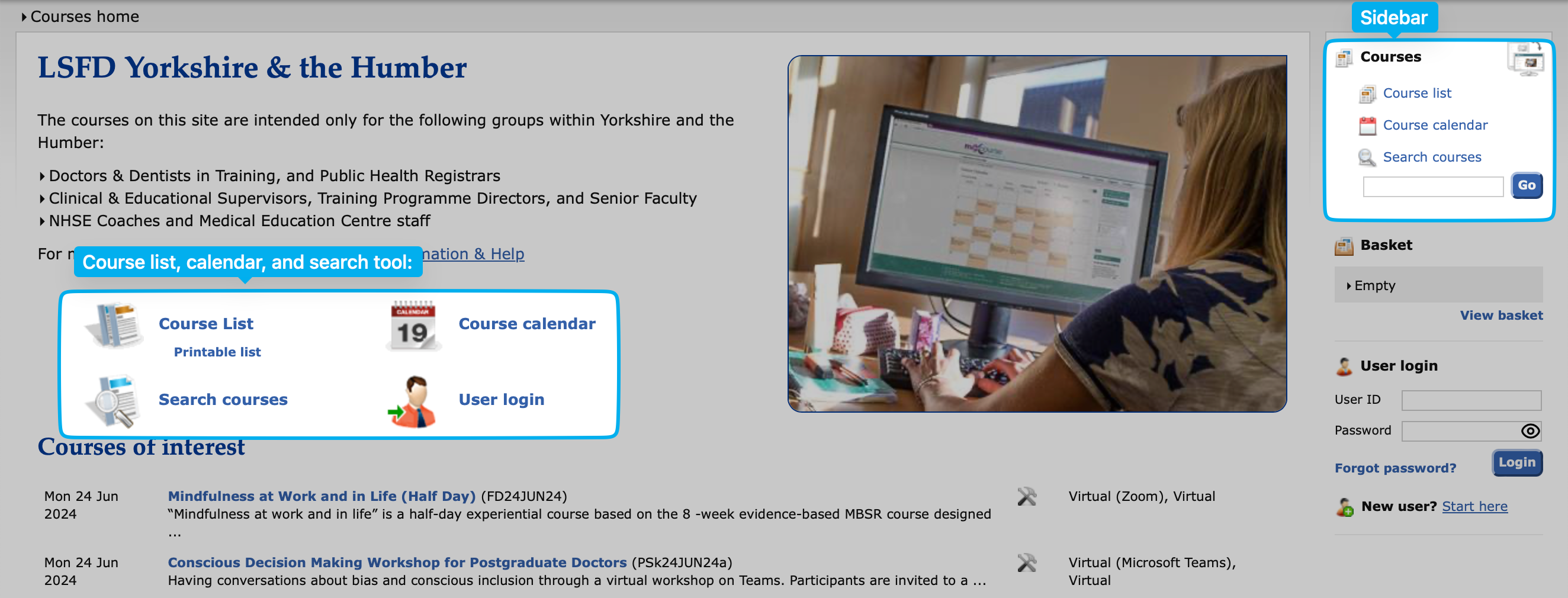
Before booking any development courses, please update your 'main occupation' in your Maxcourse account details > personal details. For help updating your details, please see LSFD Maxcourse help. Please select the Trainer/Faculty occupation that is appropriate to your specialty i.e. Medical Trainer/Faculty, GP Trainer/Faculty, Public Health Trainer/Faculty or Dental Trainer/Faculty. Without the correct occupation attached to your account, you will be unable to book ones of these courses.
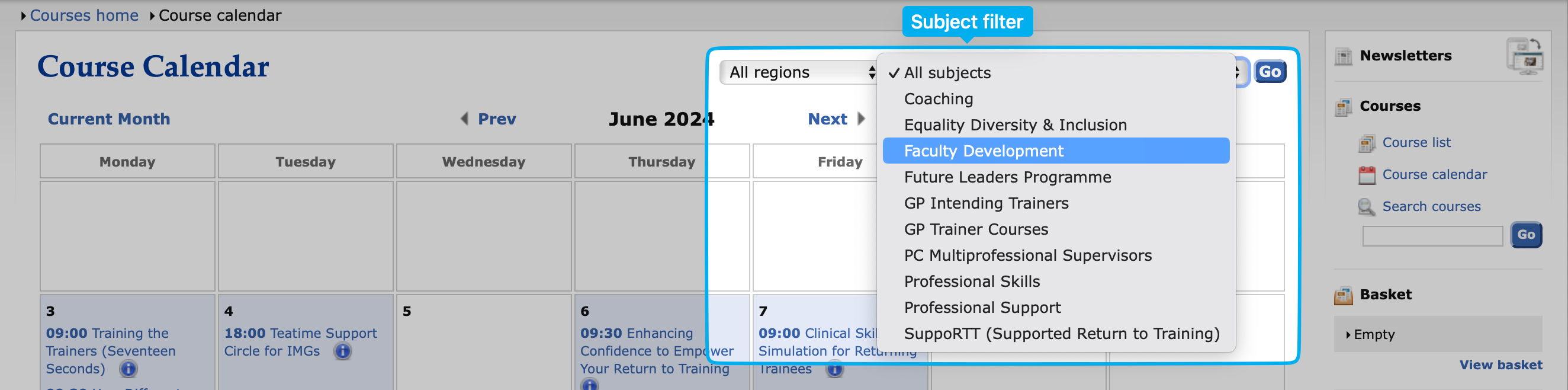
Using the course calendar
To improve the results when viewing the course calendar, use the subject filter to show only Educator and Trainer Development courses.
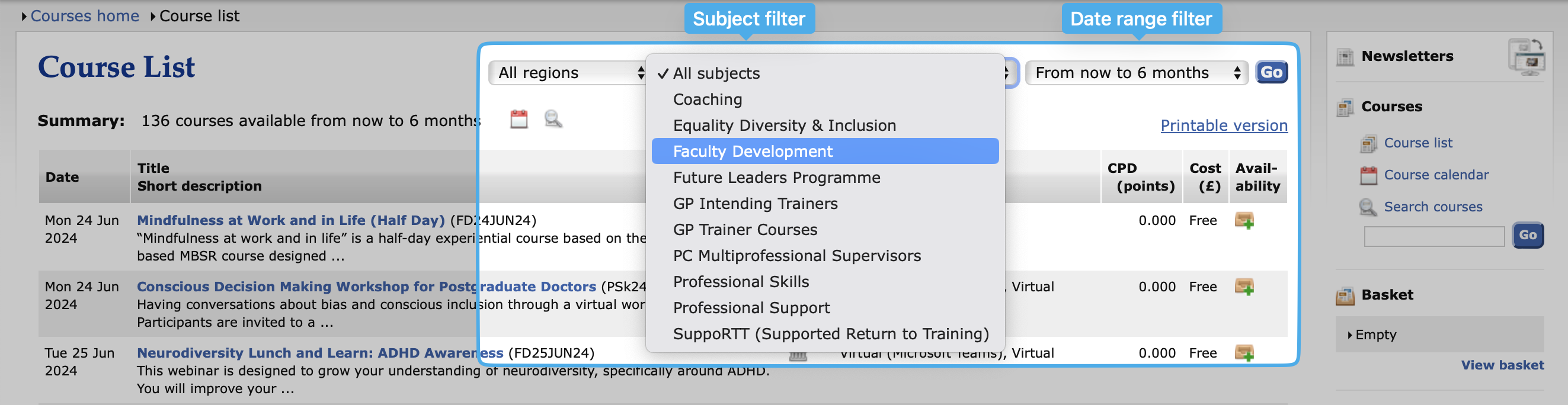
Viewing a course list
To improve the results when viewing the course list, use the subject filter to show only Educator and Trainer Development courses. Also use the date range filter to show the desired period.
eLearning opportunities
Our Neurodiversity eLearning courses were developed by Lexxic and are hosted on our virtual learning platform, Blackboard.
For specific instructions on accessing these courses and obtaining certificates of completion, please read our guidance: How to access the Neurodiversity eLearning for Educators and Trainers.
Neurodiversity in the Workplace
This short eLearning course will support you to:
- Understand what neurodiversity is and how to talk about it.
- Use neuro-inclusive communication.
- Be able to distinguish between common neuro differences.
- Be encouraged to think about the unique strengths that neurodivergent individuals bring to the workplace.
- Understand how neuro differences affect individuals in the workplace.
- Be able to understand and explain the value of neurodiversity.
- Understand the key approaches in creating a neuro-inclusive workplace
- Be aware of workplace adjustments to empower neurodiversity in the workplace
Neurodiversity Awareness for Line Managers
This short eLearning course will aid anybody involved in supporting postgraduate doctors and dentists in training to:
- Understand and explain the value that neurodivergent individuals bring to the workplace.
- Understand how neuro differences can impact individuals in the workplace.
- Discuss how neuro differences can manifest in individuals in the workplace, including possible gender differences.
- Explain good practices around supporting and empowering neurodivergent individuals in the workplace.
- Suggest and implement workplace adjustments to support and empower neurodivergent team members.
Support contacts
If you experience any difficulties in booking a place on one of the Educator and Supervisor Development courses, or have any general queries, please email england.LSFDcourses.yh@nhs.net.